Introduction
The economic and legal spectrums in modern business operations play a critical role in shaping the environmental aspects of enterprises. Fundamentally, their influence has grown tremendously with the growth of trans-state and global trade. Today, the national economic performance, including its growth forecasts, profoundly impacts vital aspects of trade within its borders, including corporate investment, labor relations, and consumption patterns. Similarly, the legal frameworks a nation-state adopts to regulate the governing principles and frameworks of contractual agreement determine how all the key market players transact and relate. Therein, they have critical pillars of global commerce.
This paper will examine the two concepts independently and their role as critical pillars of the modern business environment. The economic performance analysis will focus on the United Kingdom and Germany markets. Comparatively, analyze their recent GDP growth rates to measure their respective economic performance levels. The second part of the assignment will explore various elements of law necessary for a valid contractual agreement under the Principles of English common law. On the one hand, the country’s macroeconomic conditions wield significant power over the financial transactions operations of the enterprise. At the same time, legal and commercial agreement statutes determine the nature of their agreements.
Economic Performance Comparison: U.K. vs Germany
The comparative analysis between the U.K. and Germany will focus on their respective GDP growth trajectories spanning 2018-2022. Both are substantial European economies, with market reports ranking them as the region’s most industrialized and service-oriented economies. As such, understanding their economic performance trajectories and their drivers of growth will help provide valuable insight.
The chart below plots the annual accurate GDP growth rates from 2018 to 2022 for both countries
United Kingdom: Gross domestic product (GDP) 2018-2022)
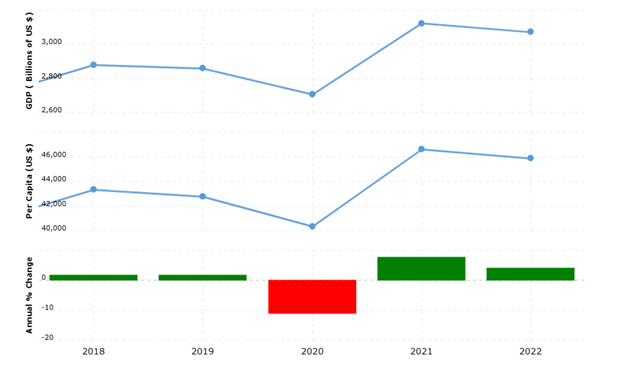
(Source: U.K. GDP 1960-2024 | MacroTrends )
Germany: Gross domestic product (GDP) 2018-2022)
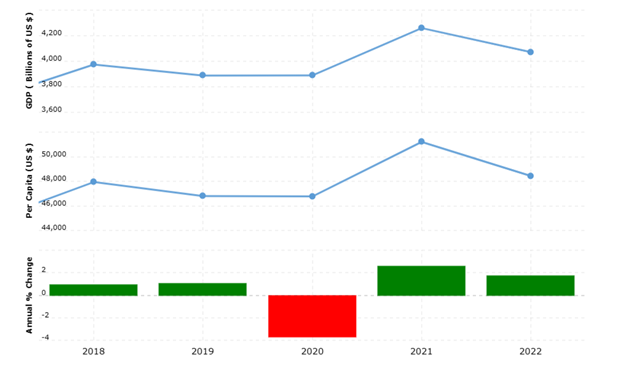
(Source: Germany GDP 1970-2024 | MacroTrends)
The charts above show various observable shifts in both countries at different points. Key among these changes was the 2020 economic downturn experienced in both countries, mainly due to the COVID-19 pandemic. Like most other countries globally, the pandemic triggered a massive lockdown of major financial systems and business infrastructure systems as a part of their initiative to comply with the health lockdown requirements of the time(Bhattacharyya & Thakre, 2021, p. 1242).The comparison of the shift in the changes of their economic curves reveals the implications of the GDP decline that was relatively higher in the U.K. compared to Germany.The latter dropped by 9.3 %, while the former declined by 4.6 %.
Interestingly, their recovery trajectories were also quite distinct between the two nations. Germany’s recovery was much slower at 3.1 % compared to the U.K.’s 7.5 % post-pandemic period.Market research shows the differences mainly because the U.K. economy is more service-oriented, so the recovery was much faster. The country’s primary industries offer banking, hospitality, and medical care services. Once the ban was lifted, they were able to resume regular operations more quickly. However, in Germany’s case, it is manufacturing-based; hence, it was much slower due to the supply chain delay issues. Across the globe, the supply value chains, especially in maritime logistics, had crumbled; therefore, the country’s key industries experienced a relatively low recovery timeline. In 2022, with the emergence of the U.K. war, there was record-high inflation caused by shifts in energy prices. Germany’s decline was a mere 1.7 % during that period, mainly due to the adverse impacts of the changes in the energy sector.
Based on the above observable change trajectories, it is evident that different factors drove the changes in the economic performance of the two countries. First, as Du & Shepotylo (2021) noted, the U.K. adopted much more stringent measures to avert the spread of COVID-19 compared to Germany. Moreover, the two have different supply chain models, with disruptions causing a more significant impact on Germany’s economy than on the U.K. In addition, the U.K. is less dependent on industrial operations than Germany, hence the higher resilience to COVID-19 shocks. Finally, Germany maintained its dominance in the European market to export its products in the post-Brexit period compared to Britain.Towards the future, the enemies of both countries will be mainly affected by other emerging factors in their respective markets, such as changes in labor relations dynamics and consumer trends.
English Common Law Contract Agreements Obligations
The second critical factor mentioned earlier in modern business operations is variations in the contractual agreement models under English common law. All enterprises operating within any specific jurisdiction must understand with great certainty the nature of the statutory frameworks of the legal contracts. Preliminary research indicates that a contract must satisfy several core requirements to be considered valid and legally binding. First, an undisputed agreement between the parties involved must be gained through mutual consent(Penner, 1996, p.330). Previous notable cases, such as the Carill vs Carbolic Smoke Ball Co., helped expand the interpretation by establishing that advertisement agreements constitute part of contractual agreements between two companies.
Secondly, a contract must reveal an objective intention for all signing parties to fulfill certain legal obligations to each other. Under Common, these “Legal Intentions” are extensive and depend on specific countries.Thirdly, English common statutes assert that a certain degree of consideration must be shared among both parties(Penner, 1996, p. 333). To explain, the buyer, for example, must explicitly show consideration to acquire a particular product or service from the seller. In some cases, like Chapelle and Nestle, it isnoted that a promissory agreement may constitute a valid contract as long as both parties agree on the stipulated terms of the promise. The fourth element of a contract considered obligatory is the certainty of terms among both parties. In essence, it is imperative that parties fully understand the contents of their contract so that it can be considered legally binding. Finally, a contract must be entered into by entities with a “Legal Capacity” to do so. For example, people with mental disabilities or who are not legal are considered to have the prerequisite capacity to enter into any form of legal contract.
The contractual elements do not exist in total isolation across different jurisdictions but are supplemented with additional contextual factors to be legally enforceable by judicial processes. For instance, when entering a contract, parties are at liberty to set their terms and conditions as long as they are entered in good faith. The nature of each contract must also meet the regulatory standards set by the agencies tasked with governing the sector(Penner, 1996, p. 335). Other contextual aspects that may deem a contract enforceable by courts are the specific terms of contractual remedies in the event of any violations of the agreement. These primarily guide the courts in awarding retribution to parties aggrieved by contract violations.
Fundamentally, the legal sphere in modern commercial agreements is quite flexible and evolves in response to emerging issues. However, the core elements discussed above lay the foundation and, most importantly, set the scope of business operations.
Conclusion
To conclude, the dynamics of a nation’s economic performance, as shown in the comparative analysis of the U.K.’s and Germany’s trajectories, reflect its critical role in shaping a country’s business environment. In the same breath, the facets of the contractual terms and obligations based on English common law principles define the frameworks within which a company operates in particular jurisdictions. The COVID pandemic reveals the variations of each country’s economic models and helps to explain their trajectory shifts during external change.Towards the future, organizations must consider the increased understanding of the financial changes and legal systems that govern contracts. Therefore, the prudence required from companies must be based on the intrinsic interconnectedness of these two aspects in how they influence the business operation, not just in the present but also in the future.
References
Bhattacharyya, S. S., & Thakre, S. (2021). Coronavirus pandemic and economic lockdown; study of strategic initiatives and tactical responses of firms. International Journal of Organizational Analysis, 29(5), 1240-1268. https://doi.org/10.1108/ijoa-05-2020-2198
Du, J., & Shepotylo, O. (2021). U.K. trade in the time of COVID‐19: A review. The World Economy, 45(5), 1409-1446. https://doi.org/10.1111/twec.13220
MacroTrends. (n.d.). U.K. GDP 1960-2024. Macrotrends | The Long Term Perspective on Markets.https://www.macrotrends.net/global-metrics/countries/GBR/united-kingdom/gdp-gross-domestic-product
Macrotrends. (n.d.). Germany GDP 1970-2024. Macrotrends | The Long Term Perspective on Markets.https://www.macrotrends.net/global-metrics/countries/DEU/germany/gdp-gross-domestic-product
Penner, J. E. (1996). Voluntary obligations and the scope of the law of contract. Legal Theory, 2(4), 325-357. https://doi.org/10.1017/s1352325200000562