Introduction
An Indigo Assessment Report that the TTI Success Insights LTD. has provided gives a comprehensive and deep analysis of my behavior, the driving forces, skills, and motivators. The Indigo assessment is an important tool as it helps create awareness and enhances my personal growth, enabling me to have a structural understanding of my strengths and weaknesses as well as the areas of improvement. Therefore, reflecting on my Indigo assessment results will help me align my inherent traits with my day-to-day actions and decisions and vice versa, hence achieving greater success in both professional and personal endeavors.
Part I: DISC Style, Skills, Driving Forces, and Motivators
DISC is an acronym for Dominance, Influencing, Steadiness, and Compliance (TTI Success Insights LTD, 2024). According to the DISC in my indigo assessment report, it is evident that my behavioral style is a mixture of Influencing (I) and Steadiness (S), with moderate measures of Dominance (D) and Compliance (C), as shown below.
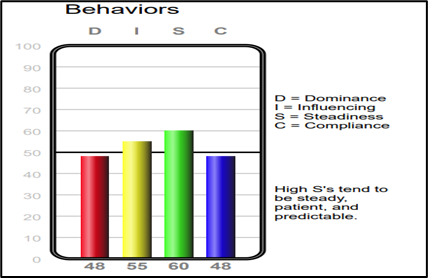
Figure 1: Showing the Behavioral Styles
The blend of all these characteristics implies that I am people-oriented, patient, and reliable. Therefore, I can easily build strong relationships with people and maintain a positive atmosphere in any situation. The top three skills that my Indigo assessment report identified include decision-making, leadership, creativity, and innovation, as shown below.
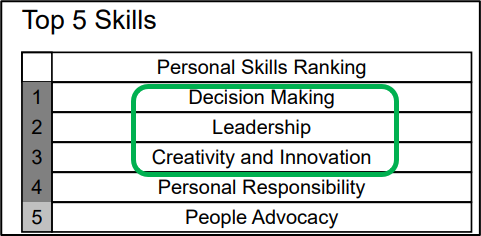
Figure 2: Showing the Top 3 Skills
These skills align with my behavioral style since I thoroughly make decisions considering various important aspects to me and the parties involved, inspire and lead people towards achieving a common goal, and encourage them to think innovatively.
My primary driving forces include Selflessness, Intellectual, and Altruism. According to Ferreira et al. (2020), primary forces are the main factors that initiate the occurrence or change of a particular event. Possessing the aforementioned primary forces implies that I strongly want to contribute without expecting a personal gain or a payback. Additionally, these aspects suggest that I am thirsty for knowledge and ready to learn while being concerned about other people’s well-being. These aspects (driving forces) deeply resonate with me because I get satisfaction in helping others and a higher level of fulfillment by better understanding my surroundings.
Reflecting on the results of my indigo assessment report, I see the importance of building on my strengths while working on my areas of weakness. I can easily harness my patience to foster a collaborative working environment and create strong relationships with people. However, I must be careful and keen enough to avoid compromising my personal needs and abilities to make decisions while trying to please and make others happy. Furthermore, as much as I work on my intellectual growth, I must stay abreast of the balance between knowledge acquisition and practical actions.
Part II: Career Impact and Work Performance
As I embark on my career as an accountant, there are various traits in my indigo assessment report that will inevitably contribute to the success of my profession. My ability to consider multiple perspectives and make informed decisions will be important in navigating and handling difficult situations and embracing advanced strategies. Additionally, as indicated in the report, my creative mindset and leadership abilities will help me lead people and teams toward embracing innovative solutions and creating a forward-thinking and established working environment.
However, I must also watch out for the challenges that may arise due to the possessed traits. My desire to lead, direct, and accommodate every person and maintain peace could prevent me from making tough decisions whenever required. Therefore, I will be unable to provide constructive feedback on many occasions. Additionally, my thirst to acquire knowledge might make me focus so much on theory instead of practical actions, hence missing important opportunities.
To better address the challenges that may arise on the way, I need to speak up for myself and become more assertive. However, this doesn’t mean I should be aggressive in any way, but I confidently express my concerns and thoughts. I will enroll in an assertiveness training program to learn how to communicate effectively and handle situations respectfully and firmly. In low-risk scenarios, I will also practice assertiveness.
I also need to get better ways of learning new skills and aligning them with practical actions. I will assign enough time for various activities by using multiple time blocks. Setting clear goals is another aspect I should adhere to when handling projects to enhance progress. Lastly, regular reviewing of everything that I do is also inevitable to avoid making unnecessary errors.
Part III: Action Plan
-
Assertiveness Training
My first action plan is to enroll in the assertiveness training program. I will enroll in an assertiveness program to enhance my advocacy and ensure I am heard. This aspect encompasses proactively attending various seminars, workshops, and courses that teach and equip one with assertiveness skills. Through gaining information from experts and embracing guided learning, I will easily learn new ways of communicating effectively and confidently. As a result, I can express myself and set clear boundaries. Additionally, I will execute role-playing exercises to experiment with new communication approaches before I can apply them in my day-to-day activities.
I will also practice assertive behaviors, such as discussing with my family and trusted friends. Debating with them will help me identify areas to work on regarding assertiveness and embrace various strategies for curbing the hurdles. Therefore, embracing assertiveness training will, to a large extent, help me to achieve healthy self-advocacy without damaging my relationships or interfering with my integrity.
-
Time Management and Prioritization
My second action plan is embracing time management and prioritization. A structured time management and prioritization approach is required to balance tangible execution and intellectual pursuits. I will adopt a technique of time-blocking, in which I will dedicate specific time intervals for research work and other commitments that need my attention. Setting clear goals will also help me to avoid redundancy and stagnation while doing my projects, hence realizing the progress. This systematic time allocation, setting achievable targets, and reviewing priorities will ensure the productivity of my intellectual curiosity.
-
Feedback and Self-Reflection
My third action plan is to obtain regular feedback and self-reflection. Yan (2020) argues that continuous self-assessment heavily depends on thoughtful self-reflection and seeking constructive feedback. I will tirelessly solicit feedback from friends, mentors, family members, and supervisors. The input from those people will shed light on areas in which I may be having issues with time management, assertiveness, and other professional competencies. Therefore, it will be crucial for me to have an open mind while receiving the feedback rather than becoming defensive.
Moreover, I will embrace self-reflection by noting areas where I encounter challenges. I will then analyze such scenarios effectively and exercise alternative approaches that will easily solve the problem and foster growth. Lastly, after recognizing my progress, I will appreciate myself with small wins as one way to maintain a motivating mindset and reinforce positive habits.
Conclusion
In conclusion, my Indigo report has given important insights into my skills, behavioral styles, driving forces, and motivators. By proactively embracing and building on my strengths and actively working on my weaknesses, I can easily unlock my potential and pave the way for success opportunities, hence, a successful career journey. By continuously exercising self-awareness, embracing a commitment to personal growth, and adapting to a wide range of situations, my ability will help me capitalize on my opportunities and navigate various challenges, ultimately bettering myself and the people around me.
References
Yan, Z. (2020). Self-assessment in the process of self-regulated learning and its relationship with academic achievement. Assessment & Evaluation in Higher Education, 45(2), 224-238. https://doi.org/10.1080/02602938.2019.1629390
Ferreira, R., Pereira, R., Bianchi, I. S., & da Silva, M. M. (2021). Decision factors for remote work adoption: advantages, disadvantages, driving forces and challenges. Journal of Open Innovation: Technology, Market, and Complexity, 7(1), 70. https://doi.org/10.3390/joitmc7010070
TTI Success Insights LTD. 2024.Indigo Assessment Report. idemudia-iziegbe-usifoh-indigomep25-4786000usbwa4-d67.pdf